
IELTS Coaching
- Listening, Reading, Writing & Speaking
- Academic & General Training
- Computer-delivered practice tests
- Weekly mock tests with band scores
- Speaking practice with 8.0 Band trainer
Personalised coaching, small batches and online practice portals for enrolled students — prepare for IELTS & Grammar the smart way at Step Ahead Institute, Yamunanagar.
Available to enrolled students — login required
These words express intent. The right modal means the right meaning. Practise five sentences daily.
— Step Ahead InstituteMost students don't fail IELTS — they fail to practise. We fix that with real training plus free tools to practise every single day.
Learn directly from a certified 8.0 Band scorer who has personally cleared the exam — not just theory, real exam strategies.
Small batches with individual attention. Your weak areas get identified and fixed with a custom study plan.
Exclusive to our enrolled students — IELTS mock tests and a full Grammar course online. Login required. Practice from home, every day.
Today's IELTS is on computer. Practise on our portal exactly like the real exam — timer, highlighter, band scale, everything.
Can't visit us in person? Join our online IELTS coaching — same personalised attention, weekly mock tests, and student practice portals.
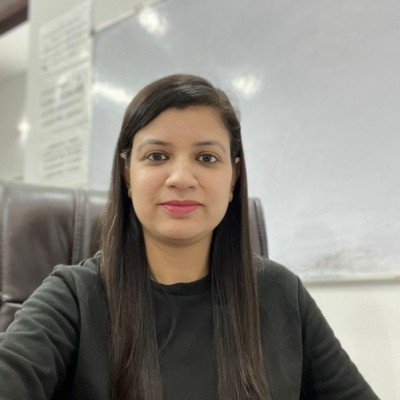
Teaching since 2009, Jyoti Malhotra is the Founder & Director of Step Ahead Institute. She holds an MBA (Honors) in Human Resource Management, along with postgraduate qualifications in Economics and Commerce, and is UGC-NET qualified.
With an IELTS Band 8.0 score and extensive experience as an educator and former Assistant Professor, she brings a strong academic foundation and practical teaching approach to IELTS and English language training.
Her focus is on helping students develop strong English communication skills, build confidence and achieve their academic and professional goals.
From zero English to your target band — choose your path and we'll walk it with you.
Free online tools we built for our students (and you!) — practise IELTS and Grammar from your phone or laptop, anytime.
Computer-delivered mock practice
Complete English grammar course
💡 Pro tip: the habit that matters is showing up every day. Thirty minutes on these portals beats a long session once a fortnight, and your own mock scores are the only honest measure of whether it is working.
Reviews left by students on our Google Business Profile. Every one of them is a public Google review.
Google reviews are being added. See them all on our Google profile.
Have you studied with us? Your review helps someone else decide.
Review Us on Google Read All Google ReviewsThese are real scores from our students, published with their permission. More of them are on our Google profile.
📸 See more results on our Google Business profile.
Express Entry draws, visa rule changes, new batches and portal updates, all in one place. The immigration items below refresh on their own.
2,500 invitations issued. Official IRCC figures, with the full draw history on the tracker page.
752 invitations issued. Official IRCC figures, with the full draw history on the tracker page.
3,500 invitations issued. Official IRCC figures, with the full draw history on the tracker page.
Expert advice, exam strategies, and study tips to help you score higher — updated regularly.
Task 1 is not an opinion essay. How to group the data before you write, the four types of chart, and the overview paragraph that most candidates skip.
Read Full Article →How the overall band is worked out, what the Listening and Reading marks mean, and why Writing is not scored by counting correct answers.
Read Full Article →Speaking for 2 minutes in IELTS Part 2 is scary for most students. Learn the PPF method (Past-Present-Future) to never run out of things to say.
Read Full Article →A line graph shows change over time, which makes it the easiest Task 1 chart to organise. How to group the lines and write the overview examiners look for.
Read Full Article →Sections 3 and 4 of IELTS Listening are the hardest. Learn how to handle academic discussions, lectures, and multi-speaker conversations to score Band 7+.
Read Full Article →The distinction that costs the most marks in Reading, stated so you can apply it in one pass: support, contradiction, or silence.
Read Full Article →Visa requirements are what your band score is measured against, and those change. Draw results and UK Immigration Rules amendments, pulled from the official sources and refreshed on its own. Facts only, not advice.
See Latest Updates →Whatever we post on Instagram appears here too — follow @step_ahead_institute to stay updated.
Academic is for university and for study permits tied to an institution. General Training is for Canada and Australia migration routes, and for some work and partner visas. A third case catches people out: a UK visa needs IELTS for UKVI, which is a different test from IELTS, so a standard certificate is not accepted for that application. Check the specific requirement before you book, because rebooking means paying twice.
It depends on the route, and the eligibility floor is often well below what the institution actually wants. Most universities ask for 6.0–6.5 overall. Canada’s Federal Skilled Worker route needs CLB 7, which is IELTS 6.0 in all four abilities, but CLB 9 is worth far more in points. The UK student visa asks for CEFR B2, which is 5.5 across the four — yet most universities ask 6.5 or more. Aim above the number you were given, and check it in writing from the institution rather than from an article.
The question has settled itself: the IELTS on paper test has been discontinued, so everyone now sits computer-delivered. It also means results come back in one to three days rather than up to thirteen, and slots are far more frequent. Practising on a screen beforehand is worth doing, because reading long passages on a display is harder than on paper and the interface adds a task you would not otherwise meet.
No, and you should be wary of anyone who does. What can be guaranteed is the work: a diagnostic in the first session, your writing marked against the published descriptors every fortnight, and spoken practice every session. Your score depends on the test you sit and how the criteria are applied that day. Anyone quoting you a band is describing one student, not a method.
Small, by design. There is a point past which marked writing and spoken correction stop being personal and start being selected from a large class, and we keep the batch below it. If you are comparing institutes, ask two questions: how many students are in the batch, and how many minutes of speaking does each student get per session. That second number decides whether your Speaking moves, and it is the one most institutes will not tell you.
It depends on where you start and how consistently you work, and we cannot give you a number without knowing both. What is predictable is the order things move in. Listening and Reading respond to technique within a fortnight because they are counted out of 40. Writing needs marked feedback and moves in steps rather than steadily. Speaking moves least predictably, because the test gives you one short sample of it. Judge progress on your mock scores month to month, not on a single test.
A diagnostic across all four skills, taken properly — timed, on a computer, under the same conditions as the real test. It produces the four numbers separately rather than one overall score, because the overall figure hides the only thing that matters for planning: which ability is capping you. The plan is written from that, and it is usually not the one you would have chosen.
Listening and Reading are timed practice with an error review, because both are scored by counting correct answers and respond to technique. Writing is written and then marked against the four published criteria, which is the only kind of feedback that moves it. Speaking is practised aloud and recorded, because you cannot hear your own hesitation while you are making it. Most of the session time goes on Writing and Speaking, because those are the two you cannot do alone.
Monday to Thursday 10 AM to 4 PM, and Friday to Saturday 10 AM to 2 PM. Sunday is closed. Fixed days can be held for students travelling in from nearby towns, so the timetable becomes part of your week rather than something you re-decide every morning. The online batch is one-to-one with flexible timing instead.
Usually yes, because the material stacks in a fixed order. What matters is that the diagnostic happens in the first session, so the trainer knows where you actually are rather than where the class happens to be.
That is a common situation and it is usually not a stamina problem. Repeating the same preparation does not move a score, because the same technique is being applied to the same weak points. What moves it is identifying which of the four criteria is capping you, and fixing that one. In most repeat cases it is Writing, because it improves least without feedback. Start with a fresh diagnostic rather than another course of the same material.
Yes. Online coaching is one-to-one with the trainer, with timings fixed around your schedule, and computer-delivered practice on the same student portals. It is a different format rather than a worse one, and for anyone travelling more than about 40 km it is usually the better decision.
They are free to use once you are enrolled. The IELTS Practice Portal has computer-delivered mock tests, a band calculator, a real exam timer and a text highlighter. The Grammar Portal is a full course with exercises, and it explains things in Hindi as well as English, which is where most of our students actually start. Both need a login, and the login comes with joining.
For classes, no. For practising at home you need any laptop or phone with a browser — nothing specialist. A phone is enough for the short daily drills; a laptop is better for a full timed mock test.
519B, Darshan Lane, Model Town, opposite Guru Nanak Girls College, Yamunanagar, Haryana 135001. Model Town is central, parking on Darshan Lane is easier than on the main thoroughfares, and it is a short ride from Jagadhri. There is a full dedicated page with timings, what a batch includes and the map: IELTS coaching in Yamunanagar.
Our classroom is in Model Town, Yamunanagar. These are the towns where enough students search for IELTS coaching that a page is worth building. Each one says how far it is, what the drive costs, and whether travelling is worth it at all — sometimes the honest answer is that it is not.
Our centre, at 519B Darshan Lane, Model Town, opposite Guru Nanak Girls College. Small batches with an 8.0 Band certified trainer, teaching since 2009.
Around 35 km from our Yamunanagar centre. Fixed batch days can be held for students travelling in, so the timetable becomes part of your week.
47 km away. Kurukshetra has institutes of its own, so the question is never distance — it is whether your writing gets marked and you speak every session.
Around 50 km. Ambala is well served already, so travelling is only worth it for small batches — ask any institute there how much speaking you get per session.
56 km — the longest journey we would call a regular commute, and we will not pretend otherwise. For most Karnal students the one-to-one online batch is the better decision.
65 km. Best for a focused block rather than a long weekly routine. Many Roorkee students are retaking the test, and repeating the same preparation rarely moves a score.
Have a question about our courses? Drop us a message and we'll get back to you within 24 hours.
We're happy to answer your questions — drop by, call, or WhatsApp.
519B, Darshan Lane, Model Town, opp. Guru Nanak Girls College, Yamunanagar, Haryana 135001
Mon–Thu: 10 AM – 4 PM
Fri–Sat: 10 AM – 2 PM
Sunday: Closed